From Egg to Baby: The Start of a Long Journey
You're born with all the eggs you'll ever have. Each cycle, rising estrogen from a dominant follicle triggers an LH surge, which causes that egg to ovulate roughly 1-2 days later.
Are you ready to get a bird's eye view of what's happening inside your body that'll ultimately lead to your baby?
The goal of this article is to establish a foundation of the relevant biology and hormones, so that you know what your eggs and your body do in order to get ready to become pregnant.
If that sounds boring, I still want you to keep reading because it's so important to be able to tell what's going on inside your body simply by listening to it. The symptoms you'll experience can let you know exactly which hormones are on the rise and what that means for your fertility.
Half of Your Future Baby's DNA Is Hiding in Your Eggs
So let's talk all about those eggs! They make up 50% of your future baby's DNA so they definitely deserve some attention.
In the previous article we talked about the fact that you've already lost millions of eggs before even hitting puberty. So the egg that you'll ovulate in any given cycle is just one of the lucky few who made it this far!
That's because you already had ALL of your eggs when you were just a tiny fetus inside your mother's womb. Pretty crazy to think about, isn't it?
All the Eggs You'll Ever Have
When your mom was carrying you — you're the pink heart in this scenario — you already had all the eggs you'd ever have. So your mom didn't just carry you, but she also carried the eggs that will turn into her grandbaby someday!
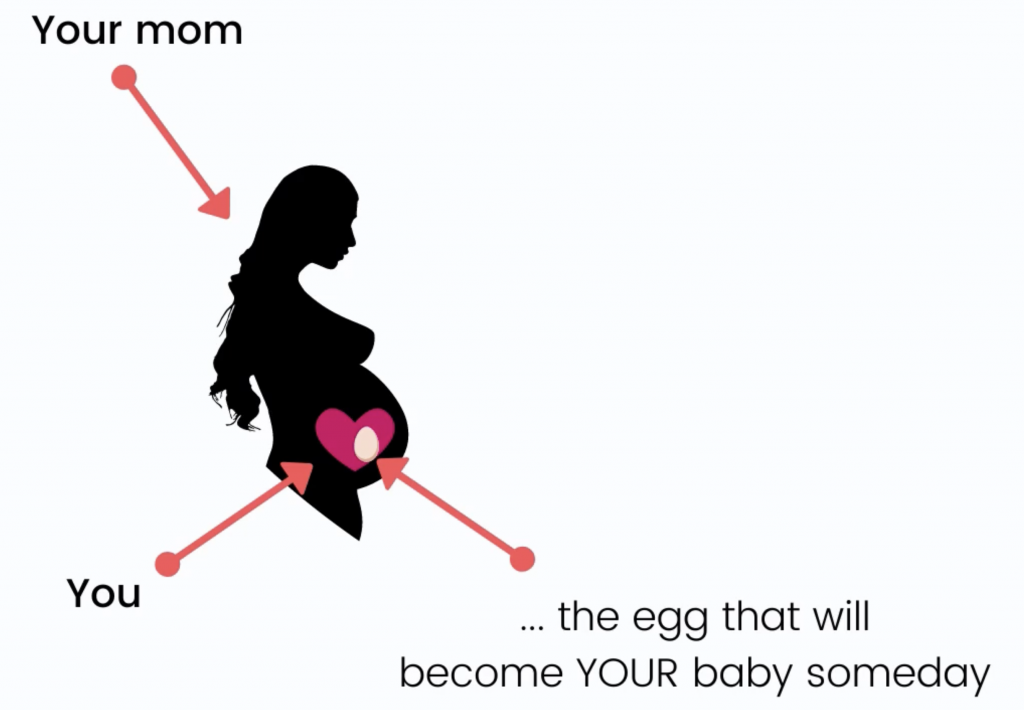
And if you get pregnant and it's a girl… that also means that when you're pregnant, you carry the eggs that may end up being one of YOUR GRANDKIDS someday.
So in a way, a pregnant woman carries her grandchild with her too.
I really love thinking about it that way, and wanted to share that with you too.
Ovaries, Eggs, and Follicles
Zooming in a bit, our eggs are securely stored inside our ovaries. And we have two of those — one on the left and one on the right. All those tiny little eggs are stored in there, but only one will be ovulated. Unless, of course, you ovulate multiple eggs at ovulation, where you may end up with twins or triplets.
Now you may have also heard the term "follicle." For example, your doctor may have counted the number of follicles when doing an internal ultrasound for fertility diagnostics.
You may wonder what the difference is between eggs and follicles — well, the follicle houses the egg. In other words, the egg is inside the follicle. It's a fluid-filled sac that nicely protects the egg that way.

The reason why you hear doctors talk about follicles instead of eggs sometimes is because eggs are too small to see on an ultrasound, so the doctor counts the follicles instead.
The egg will grow inside the follicle, but it doesn't just start growing randomly. It needs something to tell it to start growing, and also when to stop growing.
Hormones: When to Start and When to Stop Growing
And that's where hormones come into play. I won't focus on the details because it gets complicated fast, but let's take a quick look at the basics of how these wonderful hormones come together to help create your baby!

At the start of your cycle — the top left — your eggs get a message from your brain telling them to grow.
That message is received by 10 to 20 eggs at a time across both ovaries. So both ovaries now have eggs growing inside them. The eggs continue to grow, and after a week or so...
...one egg is ahead of the rest. And it varies from person to person how long this will take.
At this time, the hormone estrogen is rising. And this hormone communicates back to the brain that the other eggs can slow down their growth.
But there's (usually) one egg, the biggest one, which continues to grow bigger and bigger and bigger, and starts to prepare for ovulation. This growing egg sends out more and more estrogen every day!
And because of all that estrogen, the brain realizes that your egg is almost mature enough to ovulate!
It's like when you're really hungry and you start eating that slice of pizza—and then you have another slice, and maybe another slice, and all this food is piling up until your body realizes that you're now actually FULL! And you stop eating.
It's a little bit like that with estrogen too!
What happens next is what triggers ovulation. The brain now realizes that your egg is almost ready to ovulate. It just needs that final PUSH. And that's where the luteinizing hormone, also called LH, comes in. LH is what your egg needs for the final maturation, and then it's finally able to break through the follicle and ovulate!
Your body has saved up LH for this very moment. There's always some LH in our bodies, but right before ovulation there is a HUGE surge of LH that floods the body and gets the egg ready to ovulate, which happens 1-2 days later.

In short: your brain tells the eggs to grow. The eggs then send out estrogen. And after estrogen levels get really high, the brain causes the LH surge that sets off ovulation. And guess what — it's that sudden peak in LH that you can test for by peeing on a test stick, like this one. A positive test means you're in your "fertile window," but I'll talk a lot more about that in the confirming ovulation articles.
The Egg After Ovulation
Back to ovulation: the release of an egg by the ovary. What happens after this?
One month you may ovulate from the right ovary, and another month from the left. But it's a myth that if you ovulate from one side this cycle, you'll ovulate from the other side next month. Research shows there's roughly a 50/50 shot you'll ovulate on the same side again. So it's just as likely you'll ovulate from the same side as it is that you'll switch.
Here's another graphic that shows what's going on.

This is how the egg travels through the fallopian tube and finds a place to implant in your uterus. This whole process takes over a week. Yes, it's definitely taking its sweet time.
In case you ever wondered where fertilization occurs (where egg meets sperm), it's probably somewhere in the fallopian tube. But sperm fertilizing the egg doesn't mean you're pregnant just yet!
For that, we need to move over to the uterus. In the uterus, there's an outer layer called the endometrium. This is where the fertilized egg, or embryo as we call it, will implant. And it's this part — the endometrium — that is shed each month when you're not pregnant: you get your period.
From Egg to Pregnant
Let's look at this graphic one more time.

The brain signals that you need to start growing some eggs, which happens inside the ovaries. One egg wins the race and tells the others to stop growing, and after a few extra days of growth (and a lot of LH), gets ovulated.
The egg is then picked up by the fallopian tubes, where it will hopefully meet sperm that same day, gets fertilized, keeps on growing for several days while moving through the tubes, and eventually implants into your uterus — which is the moment you've been waiting for. Because that means you're officially PREGNANT!
That's right — you're officially pregnant once the embryo has implanted in the uterus, not when the egg is fertilized. There's no way to know if your egg was fertilized until after it has implanted.
Isn't it amazing, the way our bodies work? It doesn't take a scientist to figure out that if you take one hormone out of the mix, or have one that's going into overdrive, the whole process will look different, and becoming pregnant might not be so easy.
That's part of why the TTC School course goes deeper on this for anyone who's been trying for a while without luck.
Remember This
You're born with all the eggs you'll ever have. Each cycle, one egg wins the race and grows bigger than the rest. This sets off a cascade of hormones — ones you can monitor at home — and then... you ovulate!
The egg then travels down the fallopian tube, where it'll hopefully be fertilized with sperm pretty much right away. The embryo continues to grow and develop, creating new cells every day, until it's ready to implant into your uterus. And from that moment on, you're PREGNANT!
In the next article, it's time to focus on the other half of your future baby's DNA, and it all comes from the smallest cell of them all: sperm!
See you there!
Common questions
How many eggs do women start growing each cycle?
Around 10 to 20 eggs typically start growing across both ovaries each cycle, though normally just one becomes dominant and gets ovulated.
Does ovulating from the same ovary happen every month?
No -- it's roughly a 50/50 chance each cycle whether you ovulate from the same ovary as last month or switch to the other one.
When are you considered officially pregnant?
Once the fertilized egg (embryo) implants in the uterine lining -- not at the moment of fertilization itself.