How long does it take to get pregnant?
Per cycle, your odds of conceiving range roughly 0-25%, mostly driven by age -- about 25% at 22, dropping to around 6.7% at 40. Most couples conceive within a year of trying.
Let's talk about how long it takes — on average — to get pregnant! Before I go any further, I want to take a quick trip back to middle school.
Maybe you just got your period and you've heard your girlfriends talk about getting pregnant from sitting on a toilet seat, or swimming in the pool. And you kinda knew it was BS, but then your period was late, and you seriously started to wonder if this myth was actually a myth or if you COULD just end up pregnant without even getting CLOSE to a boy.
Well, those days are long gone and most of us know that getting pregnant isn't always that easy. Because you know that you can have sex at the exact right time and still fail to conceive.
We — and with "we" I mean the human race — are pretty terrible at procreating if you compare us to most of the animal kingdom.
Conception is complicated. It depends on a lot of different factors that we'll talk about in some of the other articles.
A look at the numbers
I want to show you the chance of conception per cycle, by age. But keep in mind that these are just averages. Although they're based on real-life data, they're still just averages, and it might be different for you.
Every month, you have between a 0% and 25% chance of getting pregnant. That range is huge, and it mostly has to do with age.
At 22 years old, you're at the peak of your fertility at 25%, while at 40 the odds drop to a 6.7% chance of conceiving. We all know that fertility drops as we age, but that doesn't mean we can't get pregnant. And it doesn't necessarily mean it'll take much longer either. In fact, someone who is 40 years old may even have a higher intrinsic fertility than the averages suggest.
So while the averages can feel a bit sobering, they give us an idea of what to expect — and life is full of surprises.
Let me show you why you should be optimistic.
I've built a calculator that shows the predicted chances of conceiving in your first month of trying, as well as after a full year. Try it out yourself.
Let's look at an example. Remember how I said the odds of conceiving for a 40-year-old are about 6.7% per cycle?
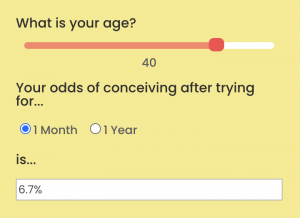
After a year of trying, that means there are, on average, more 40-year-olds who got pregnant than 40-year-olds who did not. See below.
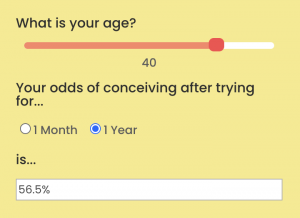
And if you're 35 years old, the odds of getting pregnant after a year of trying — on average — are almost 90%.
Conceiving in your 20s vs. (late) 30s
But just because you are, say, in your early 20s and your friend is in her late 30s doesn't mean you will conceive first.
The chances of you conceiving first are higher, but there are lots of other factors at play — your personal fertility, your partner's fertility, and the big one: just plain old good or bad luck.
Let's assume for a second that you somehow know your fertility is very high — twice as high as the average 20-year-old. In this example, you'd have about a 50% chance of becoming pregnant every single cycle. Not a realistic scenario, but I'm going somewhere with these percentages, so hear me out.
Now let's assume your 35-year-old friend has a more realistic 16.7% chance of conceiving each month.
So you have a 50% shot, your friend a 16.7% shot. Or to put it differently: you've been given a coin to flip, while your friend was given a die to roll. You have to correctly call heads or tails to get pregnant, and your friend has to roll a 6.
While your overall chance of getting pregnant sooner is much higher, that doesn't mean that's what's going to happen. So on your first cycle: you pick heads, the coin lands on tails — not pregnant. On your friend's first cycle: she rolls a 6 straight away and is pregnant.
It's a silly example, but it makes the point: these are averages, and you can't just apply them to yourself, because there's so much more involved.
It's not as bad as you think
Fertility does decline with age. But it's not nearly as bad as it's generally portrayed. In fact, you've been living with a decline in fertility since pretty much forever. Here's a graph to help visualize things.
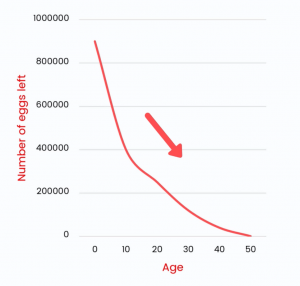
This graph shows the estimated number of eggs you have left at any age. As you can tell, you peaked early. You and I don't have nearly as many eggs as we had when we were born.
All those eggs, gone before hitting puberty — without ever having the chance to be ovulated. So egg-wise, we're all way past our prime.
I want to reframe the way we think about the decline in eggs. Yes, we lost the majority of our eggs. But most people who have kids got pregnant in their 20s, 30s and early 40s. It's still very much possible to conceive. That's something we shouldn't lose sight of.
Besides, you only need one good egg.
One more graph, something even more mind-boggling. Starting the count at birth doesn't even tell the whole story — the decline actually starts before birth.
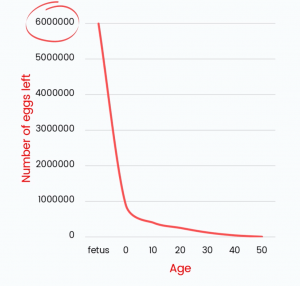
Look at that drop. By the time you're born, you've already lost millions of eggs. As a fetus, you had about 6 to 7 million eggs inside newly developed ovaries. By the time you're born, there are only about a million left.
This is an overly simplistic view — egg quality is a whole separate conversation — but it puts things in perspective. Anyone who has ever gotten pregnant already lost millions of eggs, and they still got pregnant.
Remember, you only need that one good egg.
Remember this
Most couples are able to conceive within a year, but just because you haven't conceived so far doesn't mean something's wrong. And reaching that one-year mark doesn't mean you're not able to have kids. Some couples need help along the way, and some just need a little more time.
But one thing you can do right now is try to shift the odds in your favor — and that's what the rest of this series is here for, so you don't spend one more second wondering if you did everything you could.
Common questions
How long does it typically take to get pregnant?
Most couples conceive within a year of trying. Per-cycle odds range roughly 0-25%, depending mostly on age, so it's normal for it to take several months even when everything is working as expected.
Does age really change the odds that much?
Yes, but less dramatically than it's often portrayed. A 22-year-old has roughly a 25% chance of conceiving per cycle, versus about 6.7% at 40 -- but over a full year of trying, even at 40 the average odds of conceiving are still better than not.
If it's been almost a year with no luck, does that mean something's wrong?
Not necessarily. Most couples conceive within a year, but reaching that mark without success doesn't automatically mean there's a problem -- some people simply need more time, and some benefit from additional support.