How to Confirm Ovulation Using Basal Body Temperature
A sustained rise in basal body temperature after a low, fluctuating pattern confirms that ovulation has already happened -- the shift is driven by rising progesterone.
I've gotten so many questions about basal body temperature (BBT) charting, that a full post about it was long overdue! And luckily, it's one of my favorite topics.
Take a look at the chart below.
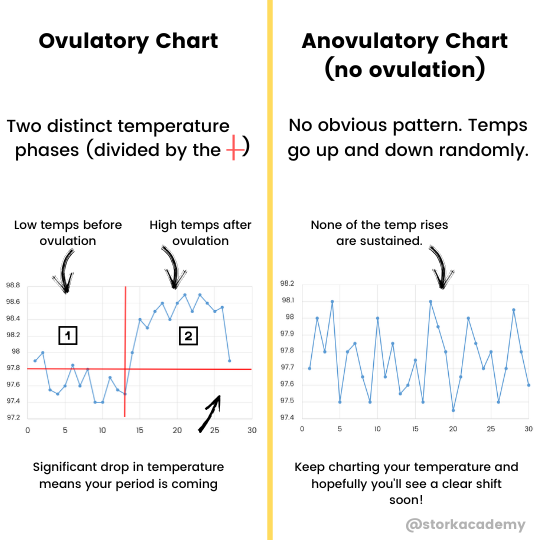
The Ovulatory Chart
Let's start with the chart on the left. This is a typical ovulatory chart with a biphasic pattern — called that because of the two clearly distinguishable phases.
Your temperature goes up and down a bit during the early days of your cycle and it all seems pretty random, right?
Keep in mind, one high or low reading doesn't mean anything on its own. But then, say on cycle day 15, you see a bit of an increase. It could just be a random spike — and if it was, you'd expect a lower reading the next day. But instead, the temps stay high, and even keep climbing.
That tells you ovulation has happened and you're no longer in your fertile window. It can take a few days before you know for sure the rise is sustained. Your temperature rises after ovulation because of the rise in progesterone — it's basically what turns your internal thermostat up.
Now right at the end of the chart, you see a drop in temperature. That's something you DON'T want to see when you're trying to conceive — it means your period is very likely coming, usually that same day or the next. If you were pregnant, your temps would stay elevated all the way through early pregnancy instead of dropping.
The Anovulatory Chart
The chart on the right is an example where temperature readings just go up and down and up and down. There's no sustained rise, which means you haven't ovulated (yet).
But just because your cycle is running long doesn't mean you won't ovulate. There's still a chance you'll ovulate a bit later, so keep checking your morning temperature every single day and watch for that sustained rise.
How to Actually Take Your BBT
A few things matter more than people expect here:
- Take your temperature first thing in the morning, before you get up, talk, or even reach for your phone — movement raises your temperature within minutes.
- Aim for the same time each day, give or take 30 minutes. A big swing in wake time can shift your reading.
- Use a BBT-specific thermometer that reads to two decimal places — a regular fever thermometer usually isn't precise enough to catch the subtle shift.
- Try to get at least 3-4 hours of consecutive sleep beforehand for a reliable reading.
A single off-day (poor sleep, alcohol, a fever, an unusual wake time) can throw one reading off — that's normal and not something to panic about. It's the overall pattern across several days that tells the story, not any single temperature.
What BBT Can't Do
Because temperature only rises after ovulation, BBT confirms ovulation happened, but it can't predict it in advance the way an OPK or cervical mucus tracking can. If you're trying to time sex to your fertile window rather than just confirm ovulation after the fact, pair BBT with one of those methods. And if you want a more direct confirmation a week or so after the shift, progesterone (PdG) test strips are a good next step.
Common questions
How long does it take to confirm ovulation with BBT?
Usually 3 or more consecutive days of elevated temperature are needed to confirm a sustained rise.
Can BBT predict ovulation before it happens?
No -- temperature only rises after ovulation, so BBT confirms after the fact rather than predicting in advance.
What can throw off a single day's temperature reading?
Poor sleep, alcohol, illness, or an unusual wake-up time can all cause a one-off blip that isn't part of the real pattern.