Ovulation Pain and Trying to Get Pregnant: An In-Depth Guide to Mittelschmerz
Ovulation pain (mittelschmerz) affects an estimated 20-50% of women and can start before, during, or after ovulation, so it's a useful hint but not a reliable way to pinpoint your fertile window on its own -- pair it with OPKs, BBT, or cervical mucus for a fuller picture.
Let's talk about mittelschmerz (German for "middle pain") — the confusing, sometimes not-so-friendly pain that shows up around ovulation for some women, and never for others. If you've felt it and wondered whether it's just you: it's not. Let's go over what it feels like, what causes it, and whether it can actually pinpoint ovulation.
What does ovulation pain feel like?
Ask a group of women to describe it and you'll get a whole range of answers. It generally involves cramps or achiness around the ovaries, but the specifics vary a lot:
- Dull ache or tugging sensation in the ovaries/pelvis
- Sharp, stabbing pain on one side
- Sudden pinching or tingling
- Bad period-like cramps
- A brief but intense jolt of pain
- General heaviness in the lower abdomen
There's no one consistent "normal" here — it's incredibly subjective.
How common is it?
Despite how often ovulation cramps come up in TTC groups, studies estimate only 20-30% of women consistently notice mittelschmerz. That number tends to run higher among women actively trying to conceive, simply because they're paying closer attention to their bodies — when you're not trying (or preventing) pregnancy, it's easy to shrug off a subtle twinge you'd otherwise clock immediately once you're tuned in.
What causes it?
Experts aren't entirely sure, but there are a few theories:
Rupturing follicle: the idea that pain comes from the mature follicle rupturing and releasing irritating fluid into the abdomen. Interestingly, one study using ultrasound found pain often started before the follicle actually ruptured, which complicates this theory.
Ovary contractions: the ovary may contract to release the egg, similar to menstrual cramps. But the follicle shouldn't need strong contractions to rupture, and many women have pain lasting days after confirmed ovulation, which doesn't quite fit either.
Hormone changes: estrogen and LH surge right before ovulation and drop off quickly after. These fluctuations could trigger cramps in some women, though the exact mechanism isn't clear.
The precise cause remains a bit of a mystery — but if you get tell-tale cramps, it's not "all in your head." There are several plausible explanations, even without one definitive answer.
Can ovulation pain predict the exact day you'll ovulate?
Unfortunately, not reliably. Here's why:
- It can start before ovulation. For some women, pain begins 12-24 hours before the egg actually releases.
- It can persist after ovulation. The pain can linger for hours or even days after ovulation has already happened.
- It may coincide closely, for some. In some women, pain onset does align well with ultrasound-confirmed ovulation — but even then, it's unclear whether the start, peak, or end of the pain is the actual signal.
- It can switch sides. Typically, pain on one side means you ovulated from that side that month — but not always. One study found that in some women, mittelschmerz occurred on the same side every month even though ultrasounds showed alternating ovulation sides. Our bodies aren't always great at pinpointing internal sources of pain.
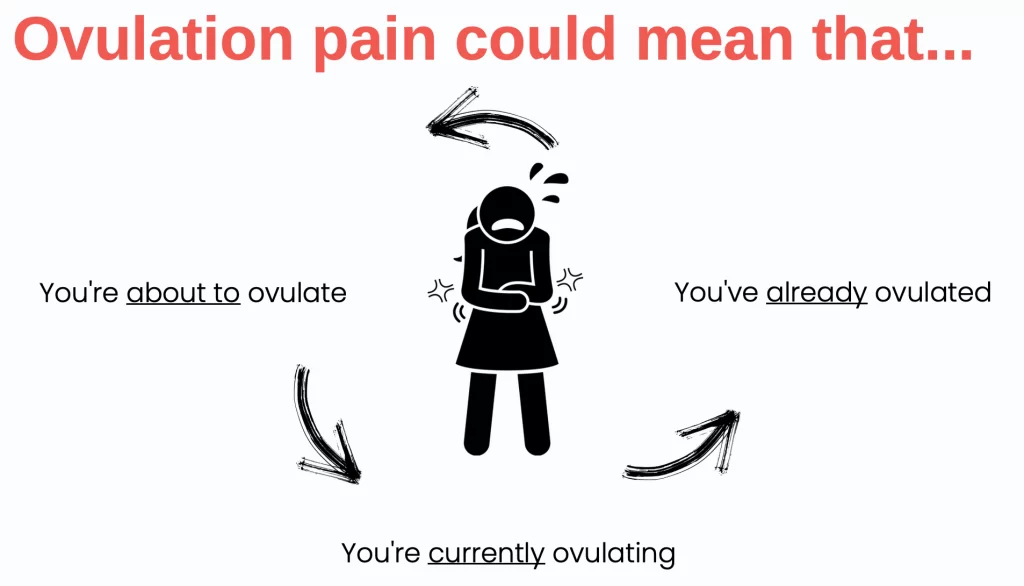
Bottom line: whether the pain means ovulation is imminent, happening now, or already over, you can't use it alone to definitively time ovulation. Treat it as helpful context, and confirm with OPKs, BBT, or cervical mucus too.
How long does it last?
There's no consistent duration — everyone's experience is different. It could be:
- Quick, sharp pains lasting seconds or minutes
- Dull aches that come and go over several hours
- Heavier cramping that persists for 1-3+ days
Your best bet is tracking your own pattern over a few cycles — consistency in your own body is more useful than any general rule.
Do you need ovulation pain to get pregnant?
No. Plenty of women conceive without ever noticing mittelschmerz. Its absence doesn't mean you aren't ovulating or can't get pregnant — it's interesting context, not a fertility requirement.
When to worry
Mild or moderate ovulation discomfort is normal and harmless. Contact your doctor if you have:
- Pain lasting more than 3 days
- Pain severe enough to disrupt your day
- Difficulty walking, moving, or standing
- Fever, vomiting, or other concerning symptoms
- Heavy bleeding along with the pain
The takeaway
Mittelschmerz is common but inconsistent — 20-50% of women experience some version of it, and it's just as normal not to feel a thing. If you want to get to know your cycle better, tracking your symptoms over a few months can be genuinely insightful, but remember it's just one piece of the puzzle. Pair it with cervical mucus, OPKs, and BBT for the full picture.
Common questions
Is it normal to not feel any ovulation pain?
Completely normal. Plenty of women conceive without ever noticing mittelschmerz -- not feeling it doesn't mean you aren't ovulating or can't get pregnant.
Can ovulation pain tell me exactly when I ovulated?
Not reliably. It can start 12-24 hours before ovulation, persist for days after, and can even show up on the opposite side from where you actually ovulated. Use it as context, not a precise marker.
When should I actually worry about ovulation pain?
See a doctor if the pain lasts more than 3 days, is severe enough to disrupt your day, comes with fever, vomiting, or heavy bleeding, or makes it hard to walk or stand.