Least to Most Fertile: The Four Types of Cervical Mucus
Cervical mucus shifts from dry, to sticky, to creamy, to egg-white (the most fertile) as you approach ovulation -- the last day of egg-white mucus is typically the day you ovulate.
Wondering what the cheapest way to track your ovulation is? Without a doubt, it's tracking your cervical mucus.
You don't need thermometers or pee sticks. And if you know what you're looking for, it's one of the easiest ways to track ovulation too.
Cheap + easy = win/win in my book.
Let's go through the 4 main types of cervical mucus.
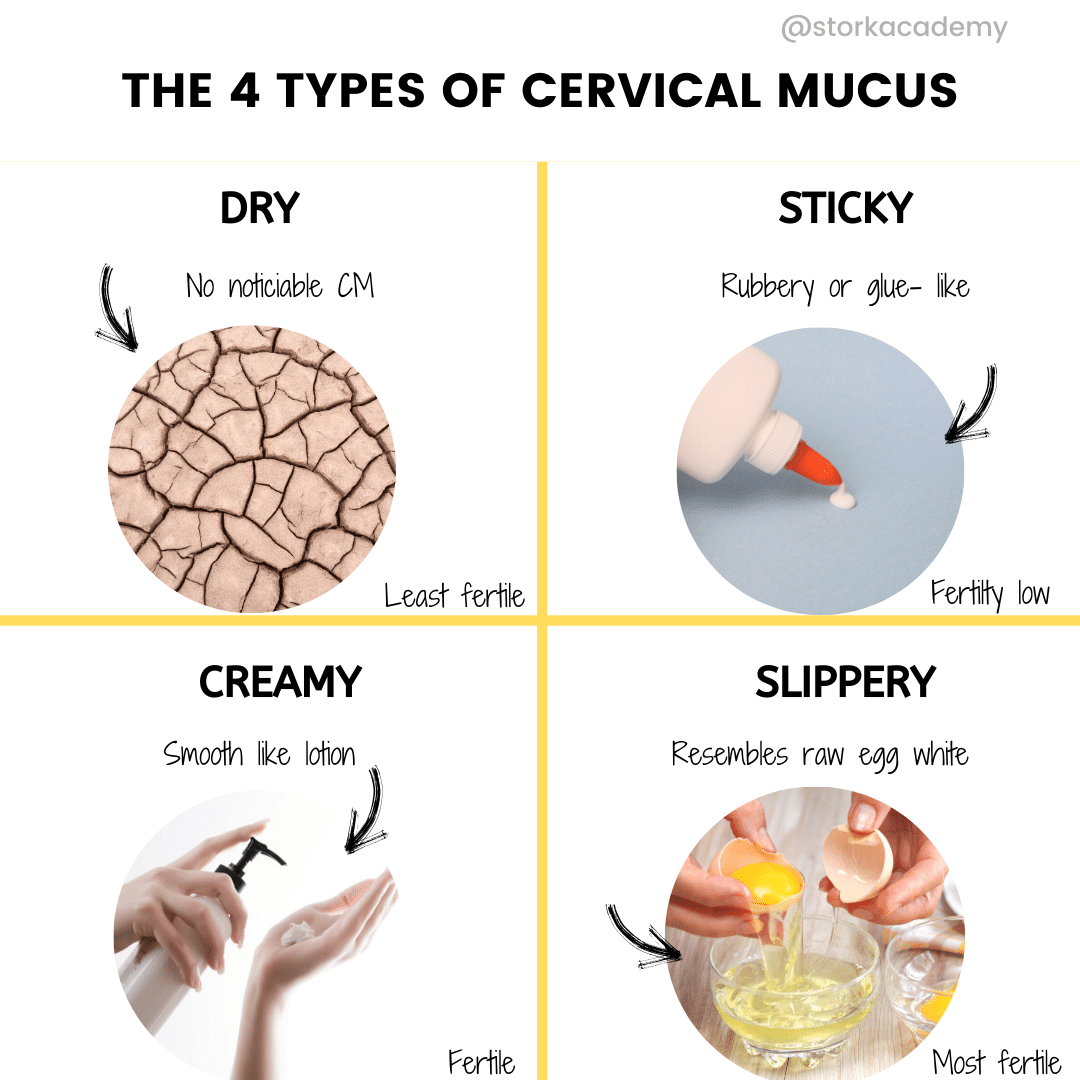
From Least Fertile to Most Fertile
- Dry: the first few days after your period. You probably won't notice any discharge at all.
- Sticky: a few days later, you may notice rubbery or glue-like CM. It can't really be stretched and it breaks easily.
- Creamy: as the growing follicle boosts your estrogen, your CM shifts to a creamier consistency — smooth, like lotion. Sperm can survive in this type of CM, and you're considered fertile once it shows up.
- Slippery (egg-white / EWCM): the most stretchy kind, resembling raw egg white. Where sperm merely survives in creamy CM, it thrives in EWCM — it can survive up to 5 days in this type.
Generally, the last day of your most fertile CM is the day of ovulation itself. So if you noticed lots of fertile CM yesterday but it's dry today, there's a good chance you ovulated yesterday.
How to Actually Check
You can check cervical mucus by paying attention when you wipe (before you pee, since urine changes what you see), or by checking directly at the cervix with clean fingers. Look at both color/consistency and, more importantly, stretchiness — that's what separates creamy from the more fertile egg-white type. There's no need to overthink it or check dozens of times a day; once or twice, at consistent times, is plenty.
It's normal for the pattern to not be perfectly clean-cut — you might see a "sticky" day sandwiched between creamy days, or notice EWCM for just one day before your temperature confirms ovulation on your BBT chart. Cervical mucus tells you when you're heading into your fertile window; BBT confirms, after the fact, that ovulation actually happened. Used together, they cover both ends of the picture.
What Can Throw This Off
A few things can make cervical mucus harder to read: hormonal birth control (which suppresses the whole pattern), certain medications like antihistamines (which dry up mucus generally, cervical mucus included), and lubricants used during sex, which can be mistaken for or mask EWCM. If your pattern seems unusually confusing, it doesn't necessarily mean anything is wrong — it might just mean cervical mucus alone isn't your most reliable tracking method, and pairing it with an OPK will get you a clearer signal.
Common questions
What does fertile cervical mucus look like?
It resembles raw egg white -- clear, stretchy, and slippery. Sperm can survive in it for up to 5 days.
When should I check my cervical mucus?
Once or twice a day at consistent times, ideally before urinating, is enough -- there's no need to check constantly.
What can make cervical mucus harder to track?
Hormonal birth control, antihistamines, and lubricants can all interfere with a clear reading.