Confirming Ovulation: How to Use Progesterone Test Strips
Progesterone (PdG) test strips confirm you've ovulated by detecting rising progesterone metabolite in urine about a week after ovulation -- unlike other tests, the line needs to fully disappear for a positive result.
Ovulation Predictor Kits (OPKs) are great. But a positive OPK doesn't guarantee that you'll actually ovulate. Sometimes the LH surge happens but doesn't go on to trigger ovulation — a so-called "LH surge without ovulation." So what can you do to confirm you've actually ovulated?
If you want to be 100% sure, only an ultrasound, a blood test, or a positive pregnancy test a few weeks later can tell you for certain that you ovulated.
But there's another way, and yes, it gives you yet another reason to pee on a stick — which is always a good thing if you ask me.
Meet the Progesterone Test Strips
As you might know, the hormone progesterone rises after ovulation. So measuring your progesterone levels is a genuinely good way to confirm you've ovulated, without an ultrasound or a trip to the doctor's office.
Progesterone itself isn't easy to detect in urine, so these strips look for something more stable: PdG (pregnanediol glucuronide), which is what your body breaks progesterone down into before flushing it out. PdG shows up reliably in urine, which is what makes an at-home test possible at all.
How the Strips Work
A week or so after ovulation, you dip the test in your urine, and it checks for the presence of PdG. If it detects 5 μg/mL or more, the test line will DISAPPEAR. That's your body telling you: progesterone levels indicate you've ovulated.
So unlike OPKs or a pregnancy test, for progesterone tests one line is good, two lines is not good — it works backwards from what you're used to.
Also unlike a pregnancy test, a faint test line here actually means the test is still negative. The line has to completely disappear before you can call it positive. There's no "getting darker means more positive" — it's the opposite, and it has to fully vanish.
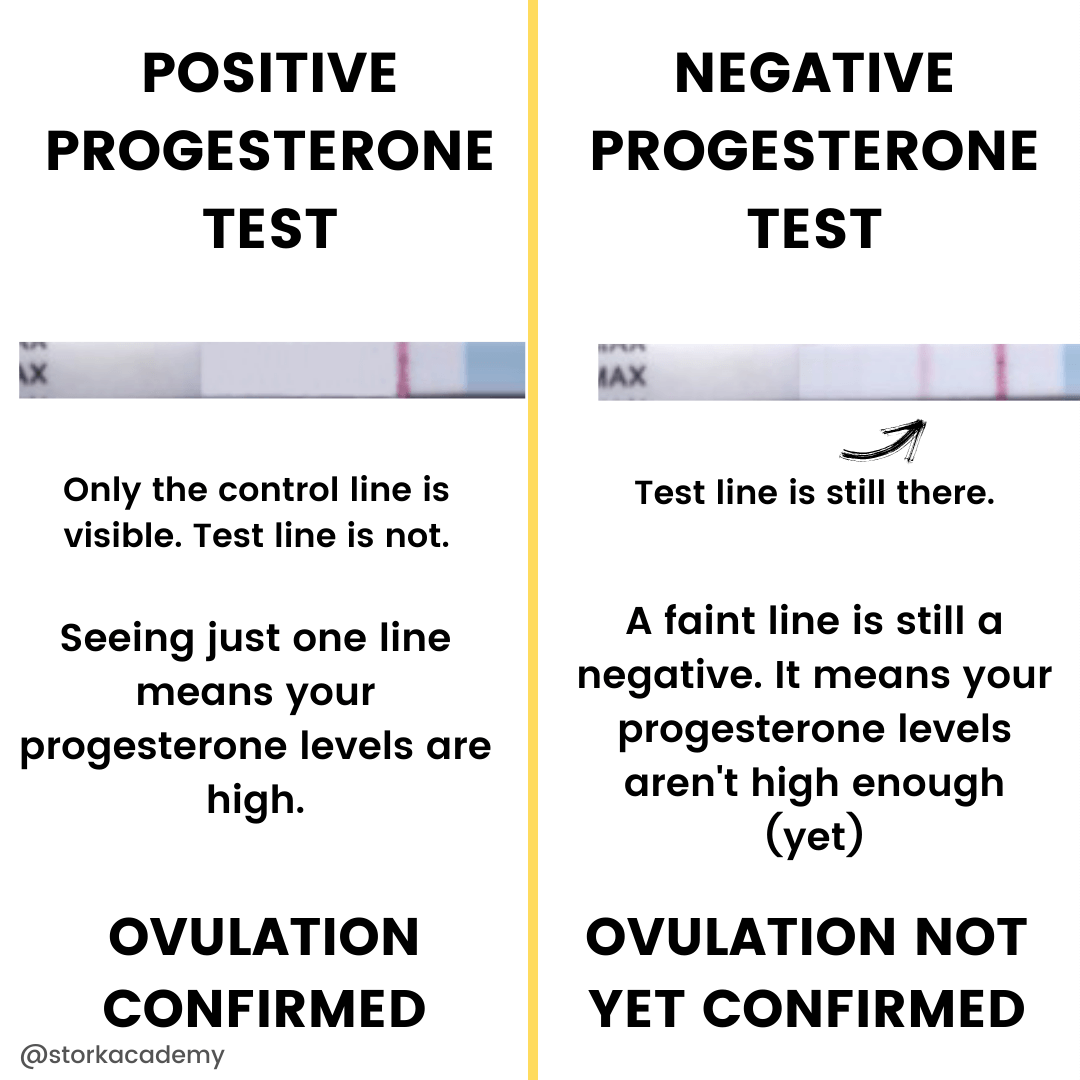
The test on the left is a positive: the line is gone. The test on the right isn't there yet. It can take about a week to 10 days after ovulation before your levels are high enough for the line to fully disappear — some people get there sooner, so just keep testing every day or two through your luteal phase.
The level of PdG the test detects (5 μg/mL) roughly corresponds to a blood progesterone level of 10 ng/mL, which is the cutoff most doctors use to confirm ovulation from a blood draw — so you're getting a meaningfully similar signal at home, just via a different metabolite.
When to Start Testing
Timing matters more than people expect here. Test too early in your luteal phase and the line won't have disappeared yet, even if you did ovulate — that's not a failed test, it's just too soon. A reasonable approach is to wait until at least 7 days past a suspected ovulation (from your OPK or BBT chart) before you start reading much into the result, then keep testing every day or two if the line hasn't disappeared yet.
If you're not sure exactly when you ovulated, pairing this with BBT tracking or your cervical mucus pattern gives you a better anchor point for when to start.
Why Bother Confirming Ovulation at All?
A positive OPK tells you the LH surge happened. It doesn't guarantee the follicle actually released an egg, or that your luteal phase (the time between ovulation and your period) is producing enough progesterone to support a potential pregnancy. If you've been trying for a while without luck, or you suspect your luteal phase might be short, PdG testing is a low-effort way to get more information before involving a doctor — and it's useful information to bring with you if you do.
What If the Line Never Fully Disappears?
If you've tested consistently for 10+ days after a presumed ovulation and the line is still visible, that's worth mentioning to your doctor — it can point to anovulation (no egg released that cycle) or a luteal phase progesterone level that's lower than expected. One low cycle isn't necessarily a pattern, but it's exactly the kind of data point a fertility workup finds useful.
Common questions
How is reading a PdG test different from an OPK?
It's backwards -- one line is the positive result, and the test line must fully disappear, not get darker, to confirm ovulation.
When should I start testing after ovulation?
Wait at least 7 days past your suspected ovulation date before reading too much into the result, then test every day or two.
What does it mean if the line never disappears?
After 10+ days of testing with no change, it may indicate anovulation or a lower-than-expected progesterone level -- worth mentioning to your doctor.