The Six Steps Between Ovulation and Having a Baby
From fertilization to a positive pregnancy test, the journey passes through six checkpoints: fertilization, cleavage, blastocyst formation, implantation (around day 8-10), a detectable hCG rise, and finally a due date 266 days after ovulation.
How does anyone ever get pregnant and deliver a healthy baby?! There are SO many steps that need to happen for it to work.
The 6 Steps After Ovulation
1. Fertilization. The best time for the egg to be fertilized is right after ovulation, since the egg's lifespan is short — typically viable for only 12-24 hours. Ideally, sperm is already waiting inside the fallopian tubes right when your egg is released, which is why sperm's ability to survive for several days in fertile cervical mucus matters so much.
2. Cleavage stage. Your egg has (hopefully!) been fertilized, and cell division has started. These are crucial early days for the tiny embryo, as it divides from one cell into several while still traveling down the fallopian tube.
3. Blastocyst stage. If you're familiar with IVF, this stage will sound familiar — most embryo transfers happen at the blastocyst stage. In IVF, this acts like a natural selection process, where only the strongest, healthiest embryos make it this far and are ready to transfer or freeze. This isn't just relevant to IVF, though; every embryo has to pass through this stage to result in a pregnancy, whether conceived in a lab or not.
4. Implantation. This is the moment your uterus has been preparing for. There's a specific window for this to happen, and in most pregnancies that end in a live birth, implantation happens around 8-10 days after ovulation. Embryos that implant after day 12 have a meaningfully lower chance of making it to a live birth — timing matters here more than people realize.
5. Positive pregnancy test. And now the moment YOU'VE been waiting for: getting that big fat positive (BFP)! If you test with a sensitive test, you may be able to pick up the pregnancy hormone (hCG) just a few days after implantation, since the newly implanted embryo starts secreting it almost right away.
6. Due date. Finally, 266 days after ovulation, your baby is due. So if you've been tracking ovulation accurately, you actually have a pretty good way of estimating your due date long before your first ultrasound — see our due date calculation piece for the full explanation.
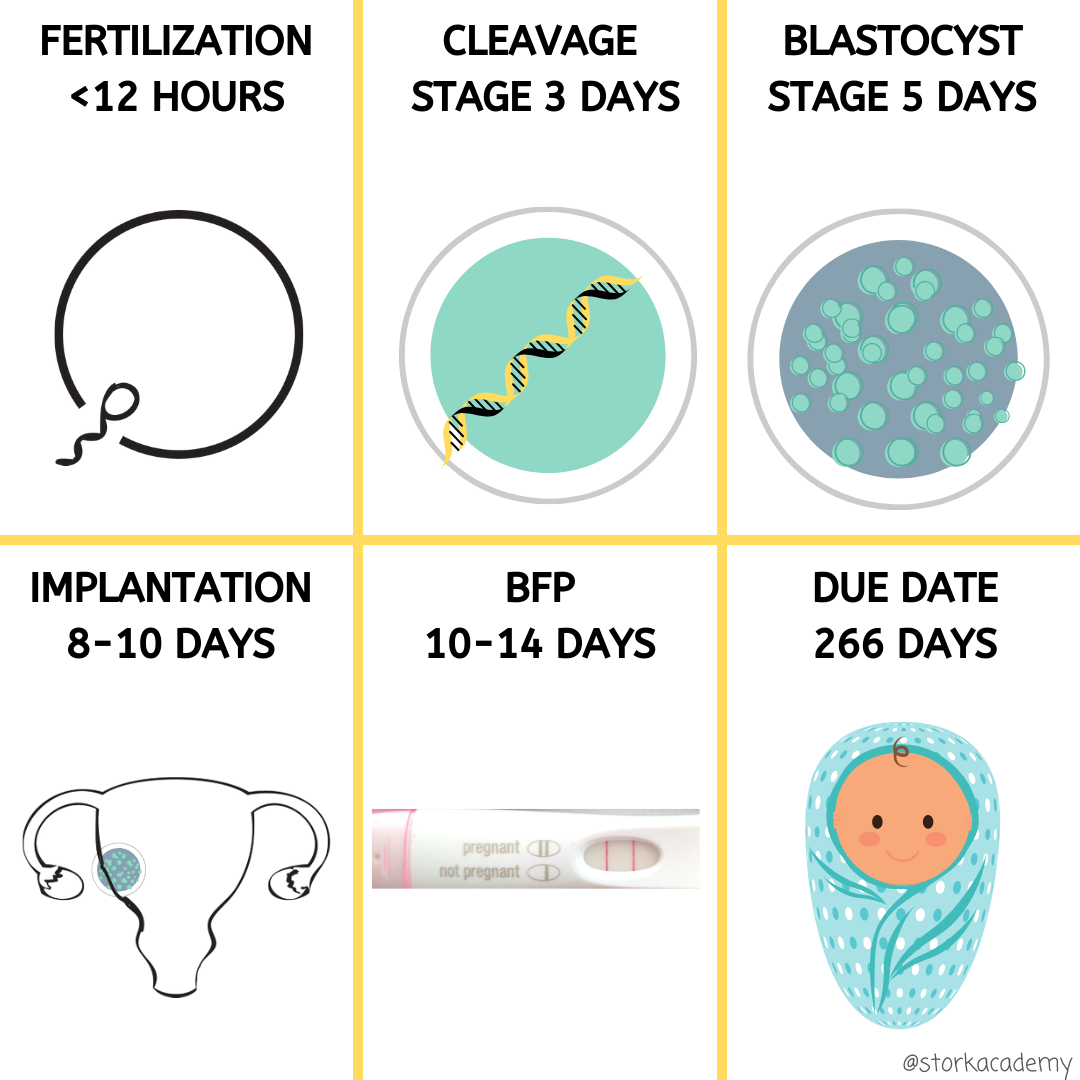
And there you have it — from egg to baby in 266 days.
Where Things Most Commonly Don't Go As Planned
Knowing the steps also helps explain why any single cycle so often doesn't result in a pregnancy, even when everything seems to line up. Fertilization itself fails more often than people assume, simply due to normal biological variability in both egg and sperm quality. Of the embryos that do get fertilized, a large share never make it to the blastocyst stage, and of those that do, not all successfully implant. Each step is its own checkpoint, and each one has a real (and mostly invisible) failure rate — which is a big part of why it takes most couples several cycles to conceive, even when nothing is actually "wrong."
This is also why the two-week wait feels so uniquely agonizing: for roughly the first week after ovulation, there is genuinely no way to know whether fertilization, cleavage, and implantation are all happening as hoped. There's no test that can tell you anything useful until the embryo has implanted and started producing hCG.
Common questions
Why does implantation timing matter so much?
Embryos that implant after day 12 post-ovulation have significantly lower odds of resulting in a live birth compared to those implanting on days 8-10.
When can a pregnancy test detect hCG?
Typically a few days after implantation, once the embryo starts producing measurable hCG.
Why does the two-week wait feel so uncertain?
Because there's no way to know if fertilization, cleavage, and implantation are happening successfully until hCG becomes detectable after implantation.