Basal Body Temping: From No Ovulation to Suddenly Ovulating
An anovulatory BBT chart shows no clear sustained temperature rise, but that can still shift into a late-but-real ovulation later in the cycle -- especially with PCOS -- so it's worth continuing to temp even past cycle day 30 or 40.
A really good way to see if you've ovulated when you think you did is by tracking your basal body temperature (BBT).
Your BBT (your body temp at rest, first thing in the morning) can tell you a lot about your menstrual cycle and whether you're ovulating.
Anovulatory vs. Ovulatory Body Temperature Charts
The chart on the left below is a typical example of an anovulatory chart — meaning you didn't ovulate that cycle. There's no clear upward shift, and the temps just go up and down. For some people the fluctuations are smaller, but the idea is the same: no clear, sustained upward shift.
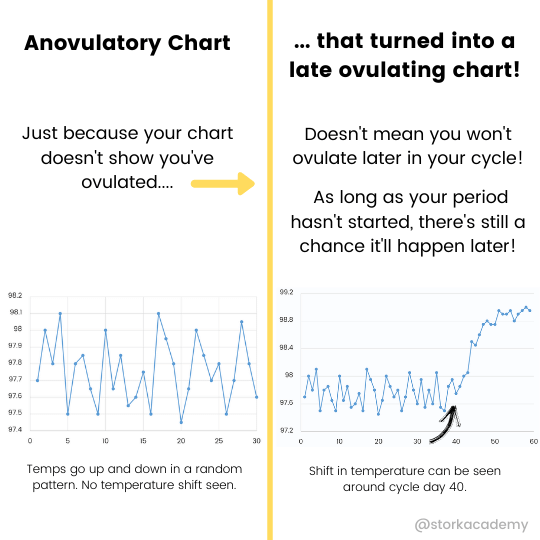
But even though your chart may look anovulatory, it doesn't mean it can't turn into a (late) ovulatory chart. That's what we see on the right.
In that example, the shift happened around cycle day 40 — a lot later than you might expect! This is especially common for people with PCOS, where ovulation can be delayed or unpredictable from cycle to cycle.
The good news: if you catch your fertile window when it does arrive — meaning you don't give up temping, and keep testing with OPKs or checking your cervical mucus — your chances of pregnancy are no different than if you'd ovulated earlier in the cycle. A late ovulation isn't a lesser one.
Why This Happens
Cycles run long for a lot of reasons: PCOS, coming off hormonal birth control, stress, illness, travel, or just normal cycle-to-cycle variability. Your body doesn't ovulate on a fixed schedule — it ovulates when an egg is actually ready, which is why a "day 14" cycle is really just an average, not a rule.
The tricky part with a long, uncertain cycle is that it's easy to give up on tracking right when it matters most. If day 25 rolls around with no sign of a temperature shift, it's tempting to assume the cycle is a bust. But as the chart above shows, some cycles just take longer to get there.
What to Actually Do
- Keep temping every morning, even when nothing seems to be happening — you need the "before" data to spot the shift when it comes.
- Pair BBT with an OPK or cervical mucus tracking, since BBT only confirms ovulation after the fact, while OPKs and mucus can give you a heads up beforehand.
- Don't stop testing just because a cycle is running long — a late ovulation still gets you the same fertile window, just later than you expected.
So I guess the moral of the story is: don't give up!
Common questions
Does a long cycle mean I didn't ovulate?
Not necessarily -- ovulation can happen much later than expected, sometimes past cycle day 40, and still lead to a normal pregnancy chance.
Is a late ovulation less likely to result in pregnancy?
No -- if you catch your fertile window whenever it occurs, your odds are the same as with an earlier ovulation.
What should I do if my chart looks anovulatory?
Keep temping daily and pair it with OPKs or cervical mucus tracking so you don't miss a delayed fertile window.