The Odds of Getting Pregnant "After" Infertility
In a 13-year New Zealand study of 1,386 couples referred to a fertility clinic, 61.7% went on to have at least one child -- 56% with help from IVF or IUI, and 44% without medical treatment.
For National Infertility Awareness Week (observed annually in late April), I wanted to highlight a study that should give everybody struggling with infertility some real hope. Hope is one of the easiest things to lose, and one of the most important to hold onto.
The study
Researchers from New Zealand followed couples who'd been referred to a fertility clinic after trying for at least a year and being labeled "infertile" for various reasons.
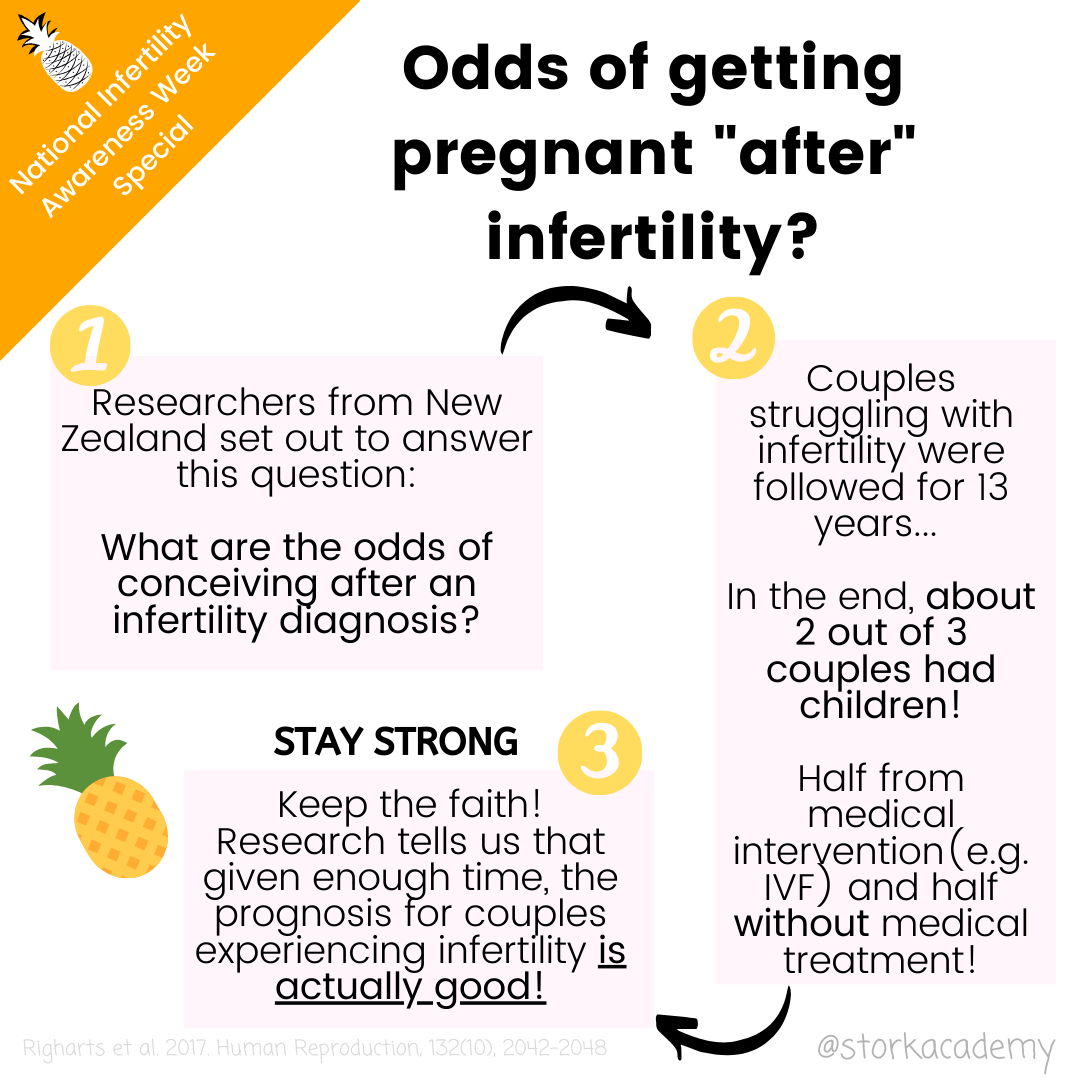
In total, 1,386 couples were included and followed for 13 years. What they found was genuinely encouraging: by the end of the study, almost two-thirds — 61.7% — had at least one child. Of the women who conceived, most (55.6%) went on to have 2 or more children. Of the couples who conceived, about half (56%) did so with the help of assisted reproductive technology like IVF or IUI, and 44% conceived without any medical help at all.
What "infertile" meant for this study
It's worth being specific about who this study actually included: couples referred to a fertility clinic after trying for at least a year without success (the standard clinical threshold for investigating infertility under 35; most guidelines shorten that to 6 months at 35 and older). That's a broad group covering everything from mild, easily-treated issues to more complex diagnoses — which is part of why outcomes varied so much within it. It's not a study of one specific condition, but of "trying for a year and not succeeding yet," which describes a lot of people who go on to conceive without ever needing a dramatic intervention.
What this actually means if you're in the middle of it
Thirteen years is a long horizon, and it's not meant to suggest that's how long it typically takes — most of these couples conceived well before the study's end. What the data does show is that an infertility label at one point in time is not a life sentence, and that both treated and untreated paths led to a child for a large share of couples. If you've hit the one-year (or six-month) mark without success, that's generally the point worth bringing to a doctor rather than waiting longer on your own — earlier evaluation tends to mean more options, not fewer. But whether you're just starting that conversation or already deep into treatment, the waiting can feel endless. Don't give up. Chances are good that years from now, you'll be looking back at this stretch as a hard chapter — not the end of the story.
Reference
Righarts et al. 2017. Human Reproduction, 32(10), 2042–2048.
Common questions
Does an infertility diagnosis mean I won't get pregnant?
No. In this long-term study, almost two-thirds of couples labeled infertile eventually had a child, and more than half of those had two or more.
Do most people need fertility treatment to eventually conceive?
Roughly half did in this study (56% with IVF or IUI), but a substantial share -- 44% -- conceived without medical help, sometimes simply with more time.